Attila, S/4HANA, BTP Fullstack Developer (EN, DE, HU)
Evaluations during AI solution design – SAP way with North Star and Golden Path

Introduction
SAP has a vision but no ready or complete product portfolio today (20.September.2026), but revealing the upcoming features and the vision they draw for their customers the enterprise way of doing AI solutions. We cannot expect from SAP in such a big enterprise environment to deliver – in minutes – an AI product portfolio with features what complies to corporate level security, software management, and at the same time keeps the robustness and stability satisfying most of the customers. New solutions has to fit under existing products. 3rd party software market is delivering fast, solutions are evolving, but they are the consumer of SAP services not part of it. SAP of course tries to control and keep customers in its own ecosystem, so that the licence fees go in pocket of SAP. LLMs and Agents can easily degrade a corporate ERP system into an API and service provider, while the sweaty and critical transactional behavior of the software is done and implemented by SAP developers internally. Of course with GenAI that work can be speed up as well. When SAP in hurry needs to respond to a market demand against their competitors they try to utilize, rebrand and expand existing solutions to fill the gap and lag in many cases, or do a constraint marriage of existing products and software components with painful integration and configuration demands and lacking transparency. Who can forget moving BOPF to basis and put it behind SEGW and SADL. It was not optimal and died fast while a real product RAP evolved. Doing such is pain to SAP internally and also for the customers to migrate extensions several times from Dynpro exits to classes, SEGW, BOPF then RAP.
This post will be about the new SAP vision (North Star architecture) covering use cases with SAP AI products and the evaluations designing the solution (AI Golden Path).
Many of the decision points can be applied however to non-SAP products as well. SAP gives an explanation and guidance
Note: vision means neither fixed, and might not operate in production at the end in this format.
The information originates from personal learning notes during examination of SAP documentation and learning materials and was made compact for easier understanding, rather than a 30 minutes marketing campaign.
AI Architecture Vision
Here is the plate with the fruits given to customers, architects and developers.
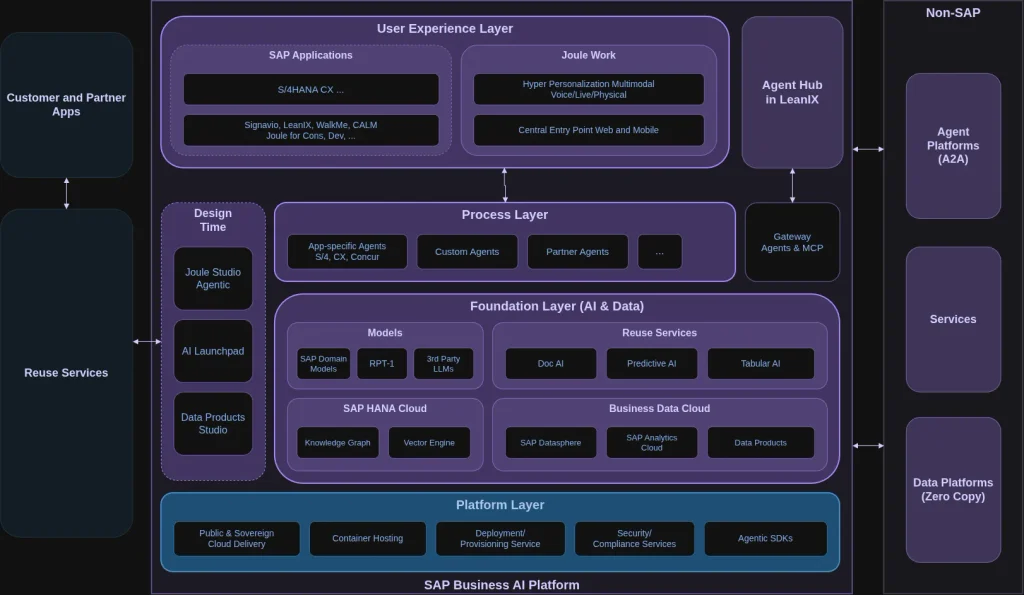
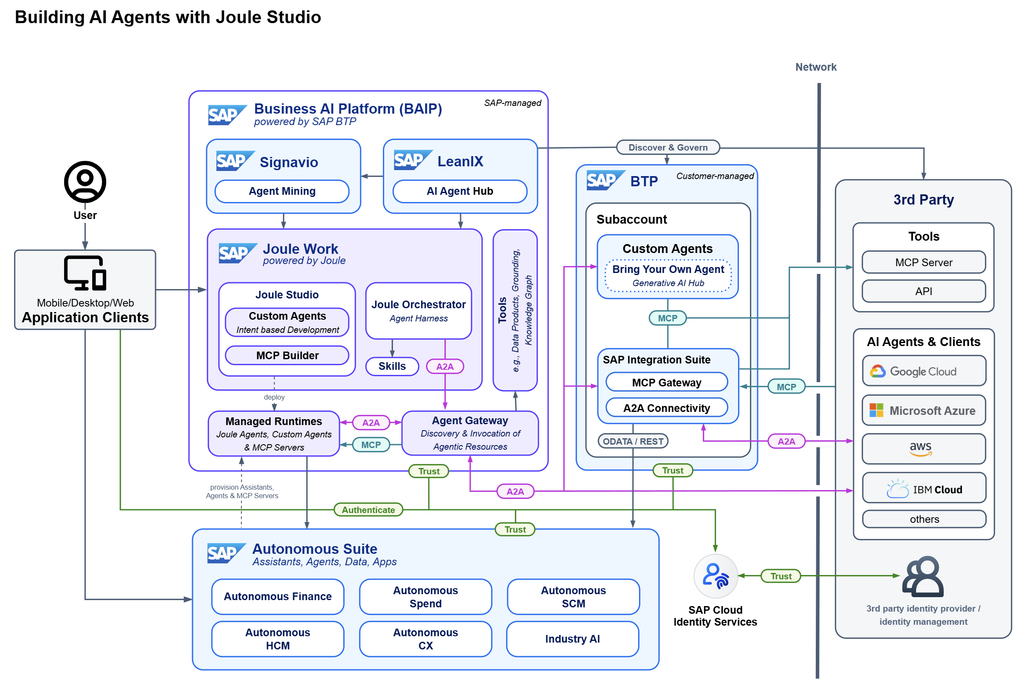
This is very high level. Each box can be expanded in the SAP Architecture Center in more detail. But here is a big bang image for you with more details, despite still not the tiniest particles ! 🙂

For developers I would emphasize the Process Layer where the business logic is defined. The existing S/4HANA or CAP services might become capability providers for agents. They still deliver the mission critical and robust transactional consistency as before, but not humans will click the whole day through. The business logic of a business object may not be moved into an agent or skill markdown file! Agents are only an additional consumer of a safe business object interface, like another consumers such as CAP service, Fiori Application or an application to application integration. Burning tokens for deterministic tasks makes also no sense, not because of cost saving, we need to save the Earth for posterity.
Joule, what else
Agentic Enterprise is not all about Joule, it is only one, but essential part of it. The fast and high data response demand cannot be routed for example through an existing S/4HANA instance beside the current load without side-effects. Data in many cases must be prepared for the use case to operate in acceptable response time. Data replications scenario for read-only access into data warehouses will come again to the foreground.
The nice looking Joule Work Chat Agent with Spaces will be the entry point for happy humans. But you as architect or developer do the heavy lifting behind.
The concept of breaking-down a complex task to reusable Joule entities will be a nice challenge. You’ll be having a lot of fun with your customers understanding their domain problems. After understanding their problem to solve, you also need to decide if that use case is a candidate of an AI solution at all. Which tools provided by SAP can cover the requirement and how to split the job between them ?
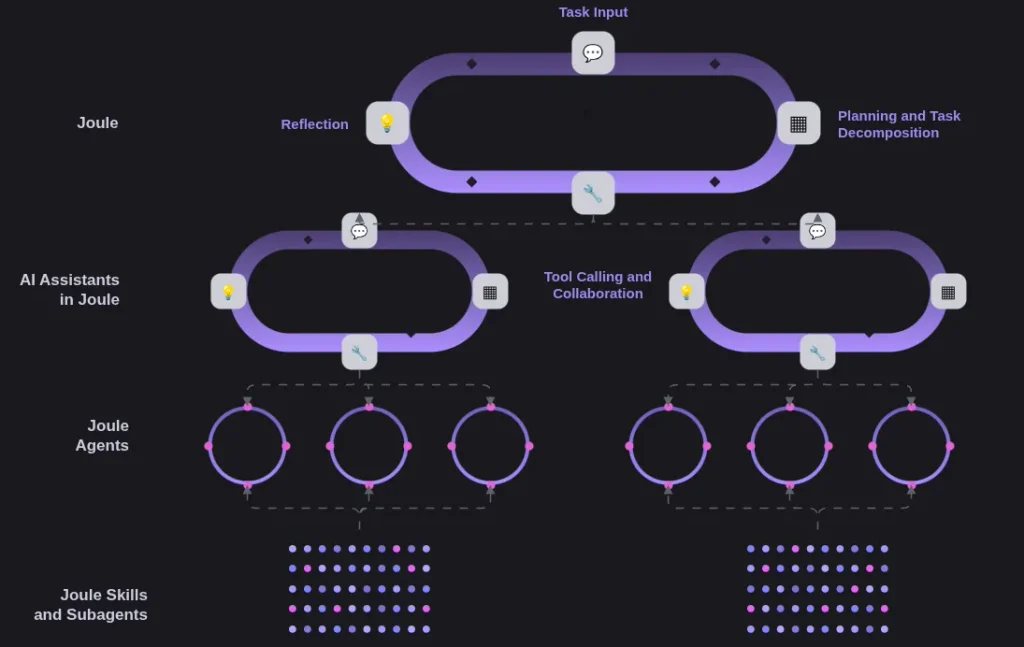
Roughly expect layering like this when slicing problems into smaller task and area of responsibilities. You will notice that this is very similar to Object Oriented Programming and separation of concerns, where each software unit has its small area of restricted responsibility.
Joule Entities, Terminology and Glossary
I would also take the opportunity to understand the difference between the different Joule entities. Joule has beautiful postfixes, and SAP marketing likes to omit them on presentations, just to confuse you more. Here is the ecosystem around Joule. You will meet these elements during implementing agents, but not necessarily all of them. It depends how far / custom you go.
Joule
SAP’s generative AI Copilot that embeds business context and expertise into AI-powered experiences across the SAP ecosystem. Joule serves as a unified AI layer that helps users across roles—from business users to developers to consultants—accomplish tasks more efficiently through natural language interactions and intelligent automation.
Joule for Business
Joule for Business embeds AI capabilities directly into SAP applications, enabling business users to interact with their systems through natural language without leaving their workflow. It provides contextual assistance, automates routine tasks, and surfaces relevant insights within the applications users already work with daily. This approach reduces the learning curve for AI adoption and delivers immediate value by enhancing existing processes rather than requiring new tools or interfaces.
Joule Work
Entry Point for End Users.
Joule Work is a central, dynamic workspace where AI agents handle busywork so people can focus on driving outcomes. It brings together data, applications, and agent workflows in one cohesive place, eliminating the need to switch between systems or manually coordinate tasks. Users express their goals in natural language, and Joule orchestrates actions across SAP and non-SAP systems to get work done, surfacing relevant insights and recommending actions based on deep business context.
Joule Work Web
The web application provides a full-featured workspace accessible from any browser, offering capabilities like full-screen workspaces and direct access to Joule Studio for building custom AI agents, apps, and automations. It serves as the primary interface for teams working at their desks who need comprehensive access to Joule’s orchestration and automation capabilities.
Joule Work Desktop
The desktop application enables personal productivity for everyday tasks by allowing Joule to act across local files and applications. Users can perform complex research, analyze data, summarize documents, and draft presentations—all in one place with enterprise-grade security and robust data protection, making it ideal for knowledge workers who need to process local content.
Joule Work Mobile
The mobile app extends the Joule Work experience to mobile devices, enabling teams to keep complex processes moving while on the go. It leverages features like spaces and voice interaction to provide fast insights and allow users to direct multi-step workflows from anywhere, ensuring business continuity beyond the traditional workspace.
Joule for Consultants
SAP Joule for Consultants is a conversational AI solution that accelerates SAP cloud transformations with expert guidance from SAP’s most exclusive and up-to-date knowledge base. It provides instant multilingual access to over 12 terabytes of expert-curated SAP knowledge, including SAP Notes, Knowledge Base Articles, and certification content. The solution can reduce knowledge search time by up to 1.5 hours per consultant per day, interpret custom ABAP code 40% faster, and minimize redesign effort by up to 50% through best-practice-aligned recommendations.
Joule for Developer
SAP Joule for Developers is a collection of embedded AI capabilities for SAP Build that accelerates the development of apps and extensions while reducing costs by up to 30%. It provides specialized, SAP-centric AI models that help developers generate code, create unit tests, explain existing code, and modernize ABAP applications. The capabilities are integrated directly into development tools, eliminating context switching and improving developer proficiency across low-code, pro-code, and automation development.
Joule Agents
Joule Agents are AI agents with business process expertise that reliably execute multi-step tasks across SAP and non-SAP systems. Grounded in SAP Knowledge Graph and SAP Business Data Cloud, these agents understand enterprise data and processes to act reliably through business applications. They can choose from a large set of tools—including Joule skills, other agents, and third-party applications—to execute plans, reflect on results, and make recommendations. Prebuilt agents are available for standard business processes in areas like finance, HR, and procurement.
Joule Assistants
Joule Assistants are AI assistants aligned to specific business roles and processes that use deep role and process context to coordinate AI agents and autonomously execute complex workflows. They understand the context users are working in, infer user intent from natural language requests, and know exactly which specialized agents to coordinate to accomplish tasks. Assistants turn isolated tasks into connected workflows with proper oversight and governance built in, enabling enterprise-scale productivity with human oversight.
Joule Studio
Joule Studio is SAP’s AI-first development environment for building custom AI agents, apps, and workflows, powered by the SAP Business AI Platform. It supports both low-code and pro-code development, combining agent building, SAP Cloud Application Programming Model development, workflows, and managed runtime in one unified environment. The platform embeds business context—including architecture, data models, process insights, and best practices—directly into the development process to generate solutions compatible with existing processes and applications.
Joule Studio 2.0
Joule Studio 2.0 represents the next evolution with an AI-first experience engineered for a faster path from idea to production. It introduces enhanced capabilities for building enterprise-ready agents accelerated by AI, improved connectivity across systems using MCP and A2A protocols, and built-in governance for managing access, performance, observability, and lifecycle controls at scale. This is what the new Architecture about.
Joule Studio Classic
Joule Studio Classic Edition provides the original development experience for building agentic AI solutions for business workflows. It offers tools for creating AI agents through intent-based development, allowing teams to describe desired business outcomes in plain language and build solutions using frameworks like LangChain and LlamaIndex for flexibility and control.
Joule Capabilities
There are different type of main use cases and their mixture covered by the corresponding features provided via Joule Work. This is what You kind of results you get and what you can do with it.
Informational
The Informational capability enables Joule to retrieve and present relevant information in response to user queries. It searches across SAP systems, knowledge bases, and connected data sources to provide accurate, contextual answers. This capability supports use cases like answering questions about business data, retrieving documentation, and providing real-time information to support decision-making.
Navigational
The Navigational capability helps users navigate SAP applications more efficiently by providing guidance on where to find features, how to complete tasks, and optimizing their workflow within the system. It reduces the time users spend searching for functionality and helps them move through complex application interfaces with confidence, particularly beneficial for new or occasional users.
Transactional
The Transactional capability allows Joule to execute business actions and transactions across SAP systems on behalf of users. This includes creating, updating, or deleting records, triggering workflows, posting documents, and performing other operational tasks. Users can initiate these actions through natural language commands, and Joule handles the underlying system interactions while maintaining proper authorization and governance.
Analytical
The Analytical capability enables Joule to analyze business data and generate meaningful insights, trends, and recommendations. It can process large datasets, identify patterns, create visualizations, and provide predictive analytics to support strategic decision-making. This capability transforms raw data into actionable intelligence, helping users understand business performance and make data-driven decisions.
How to approach the Problem to Solve ?
Everyone wants AI from management, OK OK OK OK . Does it really makes sense to do it with AI ? Actually after thorough analysis, You might find that redesigning/extending the current solution properly on a complete deterministic approach can solve the problem without AI. Simply filling money by top management decisions into unnecessary topics is a waste, rather than an advantage against your market competitors. The problems to be approached has to be evaluated first. Understand the nature of the problem before coming up with a requirement or solution explicitly asking for AI. As responsible developer or architect of your profession you must be honest. If You just want to take and burn the money from your customers without providing ROI, you become a swindler. Many SAP consultancy company do this to their rich budget customers having no competence to validate the offer… As customer apply someone internally doing quality checks on the delivery always. You can save money and maintenance costs. Sadly there are customers, where the swindler is inside the house within the IT Leadership, and taking offers from consultancy companies/departments, where they have “private interest”. Weak transparency inside giga corporates makes this possible. Nothing new in the dirty IT business…
Is AI the Right Solution
Now what to check when the stakeholders or their functional consultants come up with “We want AI” type of requirements. You need to answer some basic questions. What SAP recommends in the architecture center is actually a good basis.
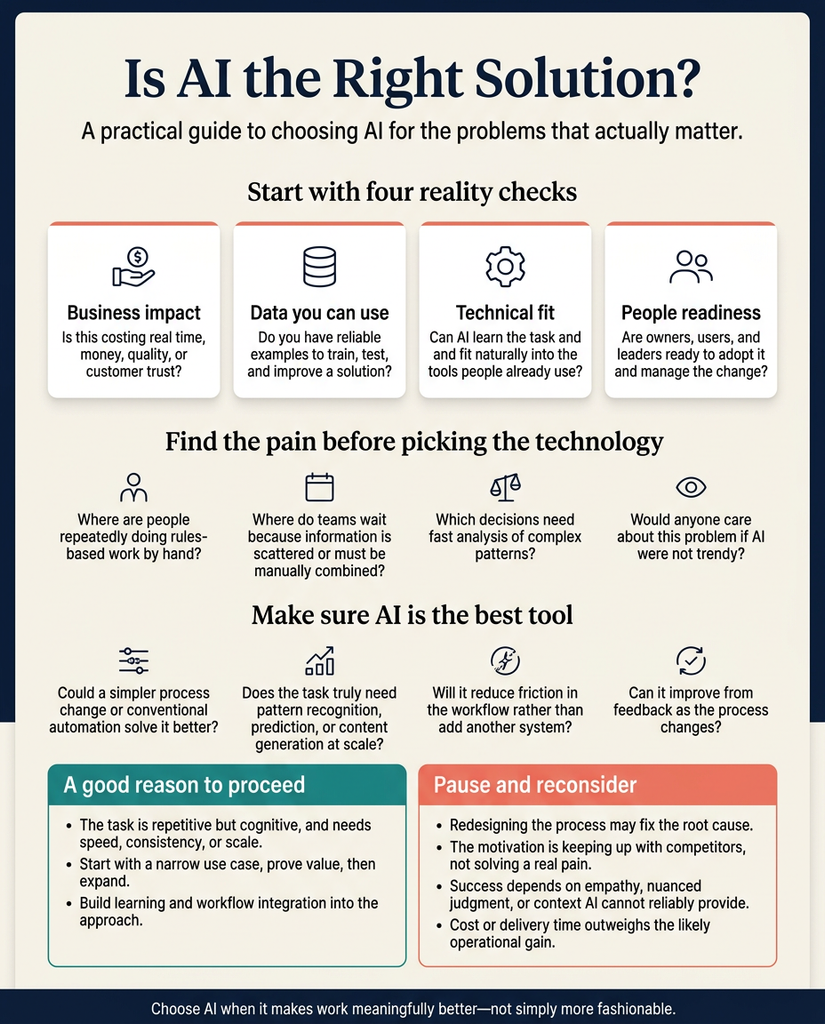
What is the Right Approach ?
Also comes from SAP as you can see, and provides you the evaluations on the problem to solve. Complex end-to-end processes might need AI support at different stages. At one point you need a prediction, later a simple document validation with a vision capable LLM, another time a complete agentic workflow orchestration to prepare a critical business operation. All requirements demand a different tool. Note: Relational Foundation Models are good for smaller datasets.
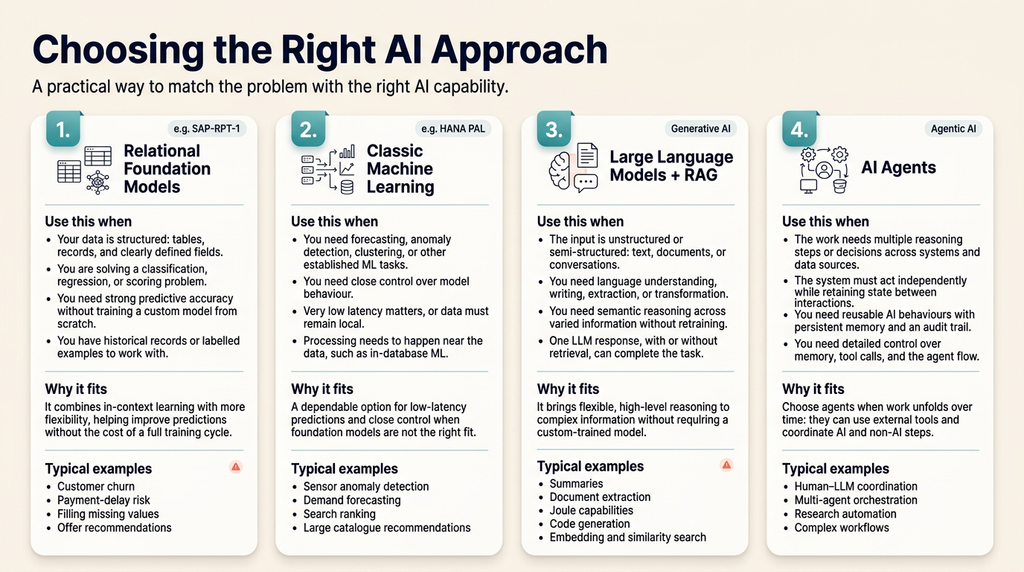
Box 3 and 4 is not mentioning You any SAP product. This is a wild west of variety of toolsets, costs saving, integration possibilities, runtime environments, programming languages, governance and security. Joule Studio is on way, but not here yet. Customers and the market were not waiting for SAP to provide the toolkits, they started to fill the gap. SAP as response embedded n8n as part of Joule Studio covered by the SAP licence implicitly. All that custom solutions so far mean additional maintenance costs for customers. Stupidness never ends, 3rd party SAP GUI clicker and typer agents were implemented across business processes and along many transactions; the employee is watching the laptop the agent doing his job with a coffee cup in hand ? I do not see any improvement here, if you still need to hire a human and provide a computer so that he/she must watch what is happening in his own tempo to not have mistakes. This is a Joke right? Where is the Return of Investment ? Why rather not batch input then , better than clean core remote public APIs ? I do not think so, this is rather an early pension you give for your loyal employees before retirement . Madness…, it is like Macro Express from 2001, combined and trained with online quiz answers to play instead of you while you’re at university the whole day and when you come back you won. It was smarter, I could leave the room (Thanks ZGabi ! Good game, play again ? )
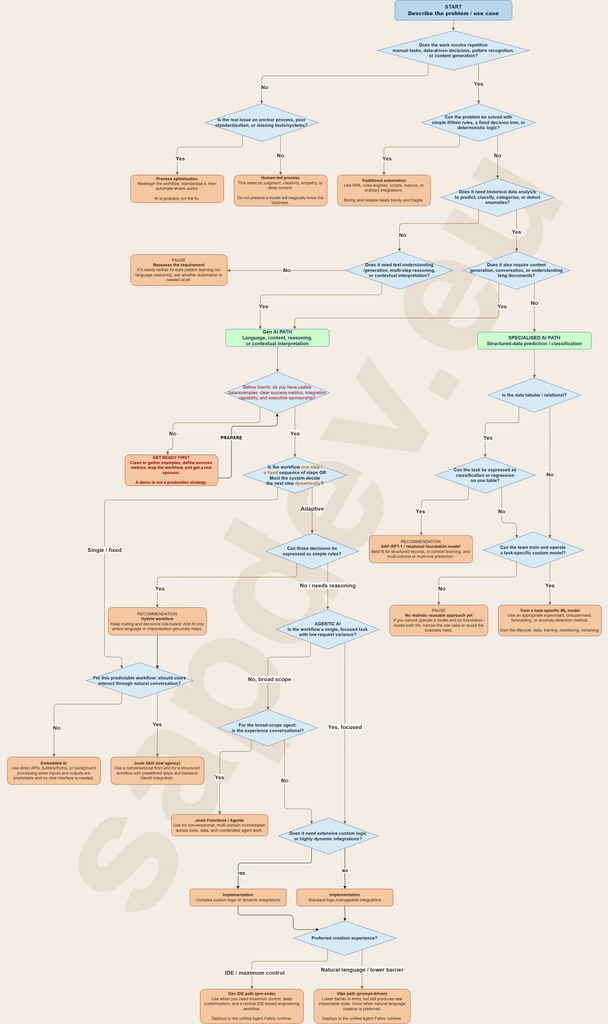
The BIG Decision Tree
All-in, here you are ! This is the combined decision tree using SAP Technology and Products. Not in all cases AI is needed, but can be solved with well known methods. Sometimes people are just lazy to understand the problem one-time to tell you an exact requirement. They are just shifting the unclarity from their plate to the development department. At the end, it might turn out after your sweaty analysis, that a new code extension with some rules will fix the problem no-one wanted to tackle.
Joule is not here yet, so you need a custom solution for agentic workflows. n8n is a good compatible choice for later migration, Langgraph is also recommended by SAP today for custom solutions. Not everything is black and white, creatively combining deterministic and agentic elements is possible. Embedding LLM calls in a normal workflow is also possible without complete agentic workflow.
Key notes
- Fix the workflow first. If the process is a mess, adding AI just gives you an expensive, faster mess.
- Rules beat models when rules are enough. Use RPA/BPA, scripts, decision tables, and standard integrations for deterministic work. No need to summon a chatbot to do an
if/else. - Structured historical data points toward specialised ML. A relational foundation model fits tabular classification/regression; otherwise, only choose a custom model if the team can run it properly after launch.
- GenAI needs more than a flashy prototype. Get data/examples, success metrics, integration access, and executive sponsorship before building.
- Low agency is usually safer. For predictable steps, embed AI into the existing UI or use a controlled Joule Skill; reserve agents for real adaptive, multi-step work.
- Agents are code-based and need governance. Pick Vibe for prompt-led creation and easier entry, or Dev IDE for maximum engineering control; both target the unified Agent Fabric runtime.
This is a every compact extract and explanation about the SAP AI universe, we space travellers need to navigate. I highly recommend the details behind SAP terminology and framework explained in the Architecture Center.